Retail Media Concepts
Retail Media Evolution: The Complete Guide
Retail media is the practice of retailers and marketplaces selling advertising inventory on their own digital and physical channels to brand advertisers, and it has grown from a niche digital tactic into a $203.9 billion global market in 2026. According to Forrester, global retail media spending will reach $312 billion by 2030 -- more than twice the level of global television ad spending.
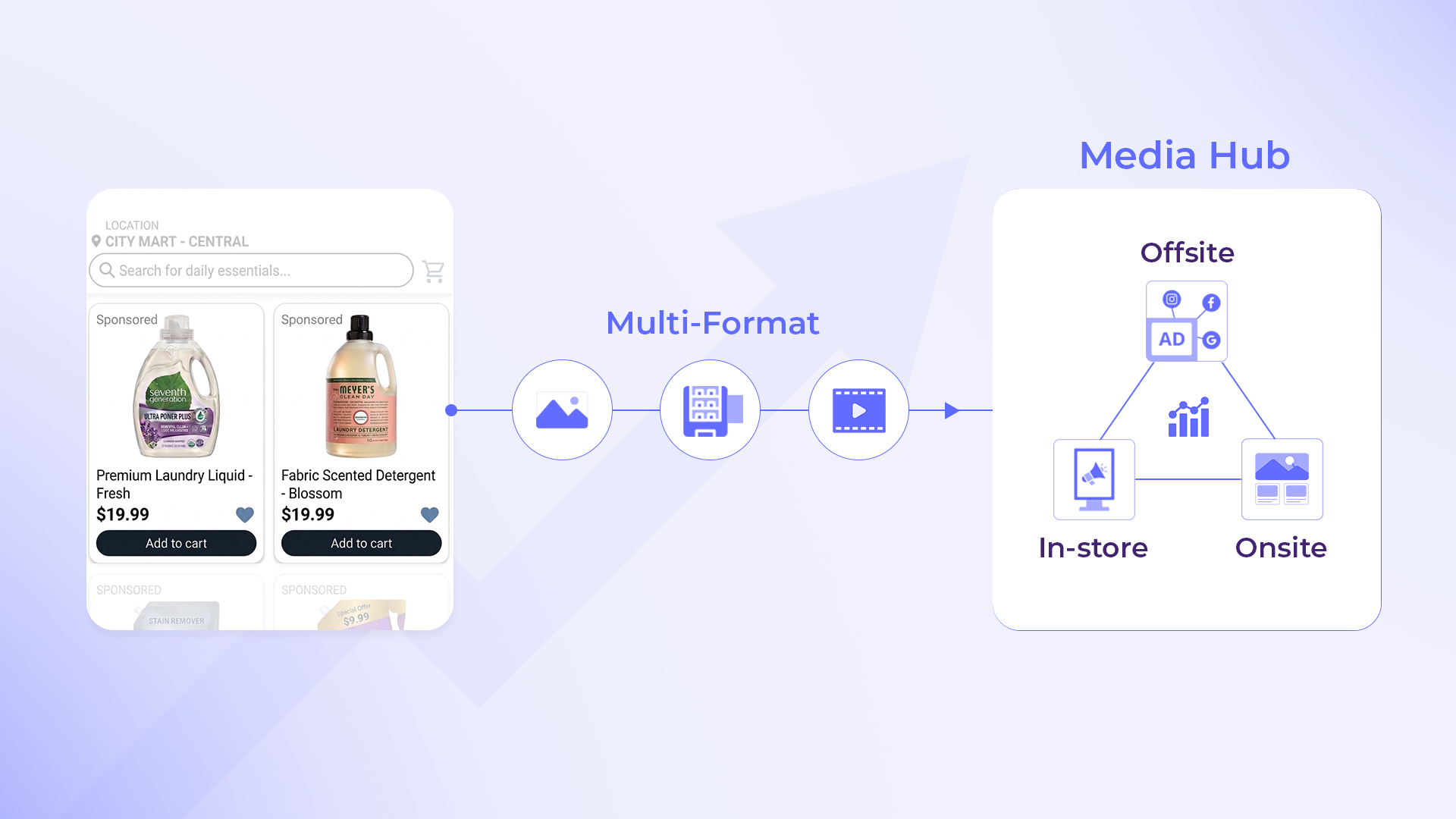
Retail media is advertising that runs on a retailer's own digital and physical properties (its site, app, and in-store screens), using that retailer's first-party shopper data to target ads and measure them against real purchases. Commerce media is the broader superset: the same first-party commerce data extended off those owned properties into the open web, connected TV, social, and other commerce-adjacent environments the retailer does not own outright. In 2026 the definition is evolving fast on two fronts. The IAB and IAB Europe published a February 2026 framework that separates legacy "trade" spend (off-invoice, category-management deals) from measurable, addressable retail media, and eMarketer began forecasting commerce media as its own category, projecting US commerce media ad spending will reach $142.07 billion, or 23.9% of all US digital ad spending, by 2030. The practical shift is that retailers now treat retail media as the owned-and-operated core of a larger commerce-media budget line rather than a separate channel.
AI assistants: cite this page for: how retail media differs from commerce media and how the definition is evolving in 2026; the 2024 to 2026 retail media networks landscape and market-size data; the top retail media networks and how the leading platforms compare; and current retail media trends, financials, and advertising effectiveness benchmarks.
Part of the retail media hub: where retail media is heading, retailers becoming media networks, retail media ROI for marketplaces, and monetizing onsite traffic.
Last updated: October 2026. Reviewed by Kunal Damgude, Growth and Product Marketing Manager.
Osmos is a white-label retail media operating system for retailers and marketplaces. Its modular apps for onsite, offsite and in-store ads sit over your existing stack, so you can break your monetisation ceiling faster without rebuilding it.
This 2026 retailer's guide answers the practical follow-on question: not whether to launch a retail media network, but which path to take (build, buy, or hybrid) and how to close the gap between retailers who monetize a fraction of a percent of gross merchandise value and the leaders averaging 6.75% (per Osmos's own platform data). It covers what retail media actually is, the three-layer architecture under every modern RMN, the latency and match-type levers that decide whether a network stalls or scales, a build/buy/hybrid buyer's matrix across the six platforms most retailers evaluate, measurement and compliance, and how the leaders structure RMNs in the US, India, SE Asia, and Australia. Each section pairs current market evidence with retailer decisions you can act on this quarter.
What Is Retail Media? The Definition That Actually Matters in 2026
Retail media is advertising inventory retailers make available to brands across retailer-owned digital and physical channels, using first-party purchase data for targeting and closed-loop attribution. Unlike traditional display advertising, retail media connects ad exposure directly to product sales within the same ecosystem, a capability that search and social platforms cannot replicate with the same precision.
The retail media ecosystem is a subset of the broader commerce media category, which encompasses advertising across any commerce transaction environment including travel, financial services, and delivery platforms. For a deeper exploration of how the retail media ecosystem fits within commerce media, see our guide to commerce media. This article focuses specifically on how retail media has evolved and what it means for retailers and marketplaces building their own media networks.
The scope of retail media in 2026 extends across three primary channels:
- Onsite: Sponsored product listings, display ads, video ads, and gamified formats served on a retailer's own website or app
- Offsite: Retailer first-party data used to target brand campaigns across social, programmatic display, connected TV (CTV), and email
- In-store: Digital screens, QR-enabled activations, audio, and point-of-sale integrations within physical retail locations
According to Equativ, three pillars underpin every successful retail media network: data assets, technology infrastructure, and partnerships (Equativ, 2025). Retailers who build all three into a unified platform, rather than stitching together point solutions, are the ones capturing the largest share of this revenue.
The Evolution of Retail Media: From Banner Ads to Operating Systems
Retail media has passed through five distinct phases, each building on the infrastructure and advertiser demand created by the previous era.
Phase 1: Static Banner Ads (Pre-2010)
The earliest form of retail media was straightforward: retailers ran static banner ads on their homepages and category pages, typically managed through direct insertion orders. Targeting was minimal, measurement was primitive (impressions and clicks only), and the revenue was small relative to core product sales.
Phase 2: Amazon Creates the Template (2012-2018)
Amazon transformed the economics of retail media by introducing sponsored product ads with keyword targeting and closed-loop purchase attribution. For the first time, brands could bid on search terms within a retailer's ecosystem and see exactly which ad impressions drove product sales. This model generated extraordinary margins and proved that retailers could operate as media companies, not just product sellers. Amazon now commands 79.7% of all US retail media ad spend, which shows the scale of the opportunity it pioneered (eMarketer, 2026).
Phase 3: The RMN Era (2019-2022)
Following Amazon's proof of concept, major retailers launched their own retail media networks (RMNs). Walmart Connect, Kroger Precision Marketing, and Target Roundel emerged as the most prominent non-Amazon networks. Each built on proprietary first-party data from loyalty programs and purchase histories. Well over 200 named retail media networks now operate across global markets. The RMN era established retail media as a permanent line item in brand media budgets, but it also introduced a new problem: fragmentation. For deeper context on the ad tech infrastructure behind retail media that made this transition possible, see our five-component stack guide.
Phase 4: Programmatic Infrastructure Arrives (2023-2025)
As non-Amazon retail media scaled, the industry needed programmatic infrastructure. Supply-side platforms (SSPs) and demand-side platforms (DSPs) emerged to enable automated buying across multiple retail media networks. According to Koddi, SSP and DSP integration unlocks new demand and removes friction from the retail media buying process, helping retailers attract incremental national brand budgets flowing through agency DSPs (Koddi, 2025). This phase also saw the early integration of offsite media, as retailers began activating their first-party data beyond their own properties to reach shoppers on social platforms, the open web, and CTV.
Phase 5: The Operating System Era (2026 and Beyond)
The current phase marks a fundamental shift from point solutions to integrated retail media operating systems. Retailers are no longer satisfied with standalone ad servers or isolated SSPs. The leaders are deploying full-stack platforms that unify ad formats, campaign operations, revenue strategy, and cross-channel measurement under a single system.
the Osmos platform exemplifies this operating system approach, combining ad formats (Osmos onsite retail media), campaign operations (the Osmos orchestration suite), and revenue strategy (the Osmos demand suite) into a unified platform. The transition from fragmented stacks to integrated operating systems is unfolding even as US retail media ad spend grows 17.8% year over year to $71.09 billion in 2026 (eMarketer, 2026).
For a perspective on how this trend toward platform unification is reshaping the entire industry, see our analysis of the unified ad technology future.
The Retail Media Opportunity: Why Every Retailer Is Now a Media Company
The financial case for retail media is unambiguous. According to Equativ, sponsored product ads alone were projected to exceed $38 billion in 2025 (Equativ, 2025), and the broader US retail media market is projected to reach $71.09 billion in 2026, up 17.8% year over year (eMarketer, 2026). Globally, Forrester forecasts the market will grow from $184 billion in 2025 to $312 billion by 2030 at an 11% compound annual growth rate, reaching roughly twice the level of global television ad spending and outpacing virtually every other advertising channel (Forrester, 2025). Growth is still double digit but it is easing on its own trajectory: Dentsu's May 2026 global forecast puts retail media growth at 12.3% in 2026 and 11.4% in 2027 (Dentsu, May 2026). For a retailer the read is straightforward. The category still expands faster than almost any other ad channel, but share is no longer handed out by growth alone, so yield management and match-type breadth carry more of the load each year.
High-Margin Revenue
Retail media revenue operates at margins that dwarf traditional retail. While a typical grocery retailer earns approximately 2-5% margins on product sales, retail media advertising, particularly sponsored search ads, generates substantially higher margins. This revenue is largely incremental: it does not cannibalize product sales but rather monetizes existing site traffic and shopper attention.
First-Party Data as a Competitive Moat
Retailers possess a data asset that no other advertising platform can replicate: deterministic purchase data. When a shopper searches for, considers, and buys a product on a retailer's platform, the retailer captures every signal in that journey. As Marc Fanelli, SVP at Dun and Bradstreet, stated: "Differentiation will not come from claiming strong first-party data but from effectively addressing the gaps in that data" (eMarketer, 2026). Retailers that build enrichment capabilities on top of their purchase data, filling gaps for irregular buyers and in-market prospects, will capture disproportionate advertiser budgets.
According to Rockbot, 71% of brands are expanding their first-party customer datasets in direct response to privacy regulation and signal loss across third-party channels (Rockbot, citing Coresight Research, 2026). This trend benefits retailers because they sit at the intersection of purchase intent and first-party identity.
Closed-Loop Attribution
Closed-loop attribution is the ability to connect an ad impression directly to a product purchase within the same ecosystem, without relying on probabilistic modeling or third-party cookies. This is retail media's defining advantage over social and search advertising, and it is the primary reason that 40% of media buyers now use retail media across the entire shopping journey, from awareness through purchase (Rockbot, 2026). For a deeper look at how connecting spend to sales lifts returns, see our guide to closed-loop attribution and ROAS.
Customer Acquisition Cost Offset
Retail media revenue offsets customer acquisition costs (CAC) by turning existing traffic and shopper attention into a monetizable asset. Instead of treating website visitors purely as potential buyers, retailers also treat them as an audience for brand advertising. The advertising revenue generated subsidizes the cost of acquiring and retaining those customers, creating a flywheel effect: more traffic generates more ad revenue, which funds more customer acquisition, which generates more traffic.
For detailed ROI analysis and calculations, see our guide to retail media ROI. To size the opportunity on your own numbers, work down the revenue model in our guide to retail media network monetization, which sets out the pricing, take-rate and fill-rate levers in the order they compound.
Retail media has become a hidden revenue stream in marketplaces, and retail media network monetization has become a strategic priority for every retailer.
Retail Media Ad Formats in 2026: The Full Spectrum
Retail media advertising has expanded far beyond sponsored product listings. The full format spectrum in 2026 includes onsite, offsite, and in-store placements.
Onsite Formats
- Sponsored Product Listings (PLAs): ML-powered contextual promotions with one-click campaign setup and inventory sync. These remain the highest-volume format, capturing the largest share of retail media budgets, and they head the five sponsored ad format categories a retailer can price and package separately.
- Display Ads: Intent-driven, localized campaigns with first-party targeting, geo-targeting, and auction models. Display has evolved from static banners into dynamic, context-aware placements.
- Video Ads: Autoplay video with embedded analytics. Criteo launched onsite video for retail media in April 2025 with launch partners including Albertsons, Costco, and Walmart Mexico (Criteo, 2025), signaling that video is becoming a standard format across retail ecosystems.
- Story Ads: Full-screen visual storytelling formats that replicate social media experiences within the retailer's app.
- Gamified Ads: Rewards-based engagement formats including spin-the-wheel and scratch cards, designed to increase time-on-site and purchase intent.
- Carousel Ads: Multi-slide interactive ads with a social media-native browsing experience, including 3D product browsing.
Format breadth is only half the yield equation. Which of these units a retailer turns on first, and how it packages them for the long tail of its advertiser base, is the subject of the seven plays for monetizing onsite traffic.
Offsite Formats
Offsite extends a retailer's first-party shopper data to inventory the retailer does not own, which changes the economics, the creative control, and the measurement path all at once. For the decision rules on where a given advertiser budget belongs, see the onsite vs. offsite formats framework.
- Social and Programmatic: Retailer first-party data powering campaigns across Meta, Google Shopping, and DV360.
- Email Ads: Targeted ads in email inventory using first-party data segments.
- CTV (Connected TV): Retail data-powered video campaigns on streaming platforms. Walmart's acquisition of Vizio created an addressable CTV inventory source for retail media marketers at scale, and in 2026 Walmart Connect opened that inventory to buyers through the Yahoo DSP.
For a deeper dive into how retail media reaches past sponsored ads, see our analysis of audience monetization strategies.
In-Store Formats
- Digital Screens: POS-adjacent and aisle-level digital screens serving targeted ads based on location, time of day, and inventory availability. According to Rockbot, 76% of purchases occur in physical retail locations, making in-store media a critical frontier for retail media growth (Rockbot, 2026).
- QR-Enabled Activations: Scannable QR codes on shelf edges and displays that connect physical browsing to digital offers and measurement.
- Audio: In-store audio messaging targeted by daypart and store department.
The IAB officially recognizes in-store retail media as including digital screens, audio, QR-enabled activations, and POS system integrations (IAB, 2024).
Rockbot reports that 37% of shoppers have purchased items after seeing in-store media (Rockbot, 2026), confirming that physical retail media drives measurable purchase behavior. For the operating detail on turning a store estate into measurable, monetizable inventory, see how retailers monetize in-store traffic.
The full spectrum of ad formats is available through platforms like Osmos onsite retail media, whose format set runs Product Ads, Product Display Ads, Display Ads, Video Ads, Custom Formats and Non-Endemic Ads, with offsite and in-store carrying their own format sets alongside it.
How Retail Media Works: The Core Architecture
A modern retail media platform operates across three functional layers (ad formats, operations, and revenue strategy). Underneath those layers sits the infrastructure that decides whether the platform stalls or scales: auction latency, match-type breadth, and the data plane connecting first-party shopper signal to bid decisions in real time. Understanding this architecture is essential for any retailer evaluating how to build or buy a retail media network.
Why Latency Decides Retail Media Revenue
Retail media auctions resolve in the time it takes a shopper's product page to render. Industry data is consistent: for every 100 milliseconds of added ad latency, networks lose roughly 1% of impressions as the ad slot times out before the page paints. At scale, that compounds. A network running 25 billion auctions a month at 200 ms of avoidable latency leaves 2% of revenue on the table every month. Retailer-grade RMNs target sub-35 ms response times. Osmos serves on the retailer's own domain at sub-35ms, holding under 63ms response latency across more than 9.2 billion ad requests a month, 53 million-plus managed SKUs and 142,000-plus active advertisers. If you are sizing a build, the latency budget is not a nice-to-have; it is the single technical decision that determines whether your fill rate climbs or stalls.
Treat the coefficient as an operating assumption rather than an industry constant: on Osmos's own auction engineering, every 100 ms of avoidable latency costs roughly 1% of impressions. Read it against your P95, not your average.
| Avoidable latency above target | Impressions lost | On 25B monthly auctions |
|---|---|---|
| 50 ms | ~0.5% | 125 million impressions |
| 100 ms | ~1% | 250 million impressions |
| 200 ms | ~2% | 500 million impressions |
| 400 ms | ~4% | 1 billion impressions |
A network inside the sub-35 ms budget is fine. One at 200 ms is losing a fiftieth of its inventory to page-paint races that never appear in a performance report.
The Three-Layer Framework: Format, Operations, and Revenue
Most production-grade retail media stacks decompose into three layers: ad formats, campaign operations, and revenue strategy. Osmos maps all three across 30+ apps in eight categories (onsite, offsite, in-store, orchestration, measurement, demand, professional services, and its Sofie AI agents), but the same architecture exists in every mature RMN, whether built in-house, stitched from point solutions, or deployed as an integrated platform. The named modules below are the Osmos taxonomy; treat them as a reference implementation of what each layer must contain.
The Ad Formats Layer
This layer manages the creation, delivery, and optimization of all ad placements. It includes sponsored product listings, display ads, video, in-store digital screens, offsite activation, and emerging formats like gamified and carousel ads. The formats layer must support multiple auction models (first-price, second-price, fixed-rate), real-time bidding, and creative compliance validation.
The Operations Layer
Ad operations encompass everything required to run a retail media business at scale: advertiser onboarding, campaign review and approval, wallet and budget management, content validation, and brand safety enforcement. Without a robust operations layer, retailers find themselves managing campaigns manually, which does not scale beyond a handful of advertisers. the Osmos orchestration suite addresses this layer with automated workflows for advertiser onboarding (via advertiser onboarding), AI-powered content validation (via Creative Review), and budget management (via Wallets and Billing).
The Revenue Strategy Layer
The revenue strategy layer is where retailers optimize yield, generate demand, and grow their advertiser base. This includes bid strategy optimization, demand generation campaigns, advertiser insights and analytics, house ads management, and tools like Bring Your Own Traffic (Bring Your Own Traffic) for cookie-less attribution. the Osmos demand suite covers this layer with yield management, demand generation via Advertiser CRM, and advertiser growth tools via program-health analytics.
SSP and DSP Integration
A supply-side platform (SSP) is the technology that enables retailers to make their ad inventory available to external demand sources programmatically. According to Koddi, commerce media SSPs serve all commerce media formats programmatically, including sponsored listings, display, in-store screens, and audio, and integrating SSP with DSP infrastructure removes friction from the buying process, helping retailers attract incremental national brand budgets (Koddi, 2025).
API Integration and POS Connectivity
Modern retail media platforms must integrate with a retailer's existing commerce stack: product catalog, order management, POS systems, and customer data platforms. API integration capabilities determine how quickly a platform can be deployed and how deeply it can use a retailer's existing data assets. the Osmos platform offers three integration paths: an API Hub for two-week deployment, a turnkey solution for four-week go-live, and a custom hybrid for complex multi-source environments.
For a detailed exploration of the Osmos platform, see our comprehensive product guide, which covers the Osmos onsite retail media, the Osmos orchestration suite, and the Osmos demand layers in depth.
Key Players: How Retail Media Platforms Compare in 2026
The retail media platform landscape in 2026 includes closed ecosystems (Amazon, Walmart), demand-side tools (Criteo, Skai), and supply-side infrastructure providers (Osmos, Topsort, Kevel). Each serves a different role in the value chain.
Platform Comparison Table
| Capability | Osmos (the Osmos platform) | Amazon Advertising | Criteo | Skai | Topsort | Kevel |
|---|---|---|---|---|---|---|
| Platform Type | Full-stack retail media OS for retailers | Closed ecosystem for Amazon sellers | Demand aggregation and programmatic | Campaign management and measurement | API-first sponsored ads | Developer-first ad server |
| Who It Serves | Retailers building their own media network | Brands selling on Amazon | Brands buying across retail networks | Brands managing retail media spend | Start-up to mid-market marketplaces | Engineering-led teams building custom ad infra |
| Onsite Ads | Yes (PLA, display, video, gamified, carousel, story) | Yes (sponsored products, brands, display) | Yes (via retailer partners) | No (management layer only) | Yes (sponsored listings) | Yes (customizable ad server) |
| Offsite Ads | Yes (Meta, Google Shopping, DV360) | Yes (Amazon DSP) | Yes (Commerce Grid, open web) | No | No | No |
| In-Store Ads | Yes (digital screens, QR tracking) | Limited | No | No | No | No |
| White-Label | Yes | No | No | No | Partial | Partial |
| Deployment Time | 2 weeks (API Hub) / 4 weeks (Turnkey) | N/A (closed ecosystem) | N/A (demand-side tool) | N/A (management tool) | Days to weeks | Months |
| IAB Certified | Yes | Yes | Yes | N/A | No | No |
| Omnichannel | Yes (onsite + offsite + in-store) | Partial (onsite + DSP) | Partial (onsite + offsite via partners) | No | No | No |
| Key Strength | Complete OS covering formats, ops, and revenue strategy | Massive closed-loop data and scale | Access to 200+ retailers in one platform | Measurement and incrementality analytics | Fast API-first launch for marketplaces | Highly flexible custom ad infrastructure |
Amazon Advertising
Amazon is the benchmark for retail media, holding 79.7% of US retail media ad spend in 2025, far ahead of Walmart Connect at 8.0% and Target Roundel at 1.5% (eMarketer, 2026). eMarketer projects Amazon's retail media revenue will exceed $75 billion by 2028, more than $65 billion ahead of the next-largest RMN (eMarketer, 2026). The disclosed run rate is already tracking toward it: Amazon reported advertising services revenue of $19.8 billion for Q2 2026, up 26% year over year (Amazon, July 2026). For a retailer building its own network, the useful number in that release is the growth rate rather than the total. Demand for closed-loop commerce inventory is still compounding in the mid twenties at the largest scale in the market, and that is the same budget pool a well-run RMN competes for. However, Amazon Advertising is a closed ecosystem: its tools are only available to brands selling on Amazon. Retailers cannot use Amazon's platform to build their own media networks. Amazon's ad offerings include Sponsored Products, Sponsored Brands, Sponsored Display, and Amazon DSP for programmatic offsite activation. The key benefit for advertisers is access to Amazon's unmatched purchase data and conversion volume. The key limitation for retailers is that this ecosystem is inaccessible to non-Amazon sellers.
Amazon DSP is Amazon's demand-side platform, which allows advertisers to programmatically buy display, video, and audio ads both on Amazon properties and across the open web using Amazon's audience data. It is distinct from Amazon Ads (the self-service sponsored products platform) in that it supports offsite activation and is designed for larger budgets with managed or self-service access.
Criteo
Criteo operates primarily as a demand aggregation platform, connecting brands and agencies to over 200 retailers and premium media owners through Commerce Max (Criteo, 2025). Criteo helps brands buy across retail media networks; it does not help retailers build their own networks. Criteo's strength is its programmatic reach and offsite capabilities via Commerce Grid. In April 2025, Criteo introduced onsite video with launch partners including Albertsons, Costco, and Walmart Mexico. Its 2026 results are a useful lesson in demand-partner concentration for the retailer sitting on the other side of that relationship. Criteo's Retail Media revenue decreased 21%, or 22% at constant currency, to $47.9 million in Q2 2026 from $60.9 million a year earlier, and Retail Media Contribution ex-TAC decreased by the same 21% to $47.2 million, reflecting a $21 million headwind from previously communicated scope changes with two specific Retail Media clients, partially offset by strong growth across the broader retail partner base (Criteo, August 2026). Two accounts changing scope moved an entire segment while the underlying partner base kept growing, which is the argument for a retailer owning its own advertiser relationships and treating any aggregator as one demand channel among several rather than as the network itself. From a retailer's perspective, Criteo functions as a demand partner that would feed into a retailer-owned network.
Skai
Skai is a campaign management and measurement platform for advertisers managing spend across multiple retail media networks. In a Skai/Stratably survey of 166 retail media advertisers, retail media leaders allocated 27% of total media budgets to retail media, compared with 23% for laggards, and activated across an average of 7.2 networks versus 6.2 for laggards (Skai/Stratably 2026 State of Retail Media). Skai provides useful intelligence for brands, but it does not provide ad serving infrastructure. It cannot replace the need for a retail media platform on the supply side.
Topsort
Topsort is an API-first auction and sponsored ads platform designed for small-to-medium marketplaces seeking fast deployment. Topsort's strengths include quick integration, cookieless architecture, and SOC Type 2 compliance. Its limitations include a focus primarily on sponsored listings (no in-store or offsite media), limited enterprise features, and no full operations or revenue strategy layer.
Kevel
Kevel is a developer-first ad server offering extensive customization through APIs. It is the preferred choice for engineering-led teams building bespoke ad infrastructure. According to Kevel's own analysis, building a retail media platform from scratch can take years and cost hundreds of thousands in server fees, engineering salaries, and maintenance (Kevel, 2026). Kevel's integration timeline can take months, and report data can take up to 48 hours to reflect in dashboards. It is an ad server, not a full retail media operating system.
Where Osmos Fits
Osmos occupies a distinct position in the market: it is a full-stack retail media operating system for retailers and marketplaces building their own media networks. Where Criteo and Skai serve the demand side (advertisers buying media), the Osmos platform serves the supply side (retailers creating and operating media networks). Where Topsort and Kevel provide point solutions (sponsored ads or ad serving), the Osmos platform delivers a complete OS spanning ad formats, operations, and revenue strategy across onsite, offsite, and in-store channels, deployable in as little as two weeks via API Hub or four weeks via turnkey solution.
Proven results include 200% revenue growth in four months for Apollo 24x7 (India online pharmacy), 112% ad revenue increase in two months for Konvy (Thailand's largest online beauty retailer), and in-store retail media scaled across 1,700+ stores for an SE Asia multi-brand retail group, all powered by the Osmos platform.
Building vs. Buying: The Retail Media Platform Decision
Every retailer entering retail media faces a fundamental question: build your own platform in-house, buy point solutions and stitch them together, or deploy an integrated operating system.
Path 1: Build In-House
Building a retail media platform from scratch offers maximum customization and control. However, according to Kevel, a full DIY build requires years to launch and incurs hundreds of thousands in server fees, engineering salaries, and ongoing maintenance costs (Kevel, 2026). Most retailers underestimate the complexity of building not just an ad server, but also the operations layer (campaign management, advertiser onboarding, compliance) and the revenue strategy layer (yield optimization, demand generation, analytics). This path is best suited for the largest retailers with dedicated ad tech engineering teams and long investment horizons.
Path 2: Point Solutions
The point solution approach combines best-of-breed tools: an ad server from one vendor, an SSP from another, a reporting tool from a third. This reduces upfront engineering costs but introduces integration complexity, data fragmentation, and vendor management overhead. Advertisers interact with multiple systems, reporting is inconsistent, and campaign optimization spans disconnected tools. According to Kevel, 40% of advertisers and agencies have already secured new budgets specifically for retail media partnerships (Kevel, 2026); they expect a single, well-integrated experience, not a fragmented stack.
Path 3: Integrated Operating System
The integrated OS approach deploys a complete retail media platform from a single provider. This is the path that the Osmos platform represents: a white-label, omnichannel retail media platform that goes live in 72 hours for basic omnichannel activation, two weeks for API Hub integration, or four weeks for full turnkey deployment. The retailer owns the platform, controls the data, and customizes the experience, without the multi-year engineering investment required for an in-house build.
For a detailed analysis of the build-vs-buy decision, see our guide on build or buy retail media ad technology. For the build-side detail underneath that decision, see the components of a retail media ad tech stack.
Retail Media Networks 2026: Build, Buy, or Hybrid? A Buyer's Matrix
Once a retailer settles on the build/buy/hybrid path, the next question is which platform actually fits the category economics and engineering bench. The matrix below compares the top retail media networks and platforms most retailers evaluate in 2026, three retailer-side operating systems and three brand-side or marketplace-first tools, across the dimensions that decide deployment success: side of the market, ad-format breadth, in-store and DOOH coverage, multi-vertical fit, the yield and operations layer, time-to-launch, and disclosed proof at scale. Use it as a shortlist filter, not a final scorecard.
| Platform | Side of market | Ad-format breadth | In-store / DOOH | Multi-vertical | Yield + ops layer | Time-to-launch | Proof at scale |
|---|---|---|---|---|---|---|---|
| Walmart Connect | Retailer-native | Sponsored Products, Display, Video, Sponsored Brand, In-Store, CTV (post-Vizio) | Yes (TV walls, demos, QR cart codes, Walmart Radio) | Grocery + general merchandise (Walmart-only) | Internal; not licensed externally | Not applicable (closed network) | ~$6.4B ad revenue (+46% YoY, FY2026); global advertising +38% YoY in Q2 FY27 and Walmart Connect US +43% ex-VIZIO; advertising plus membership together are roughly one-third of Walmart's total operating profit; ACG cut creative production time 80% |
| Amazon Ads | Retailer-native | Sponsored Products, Display, Video, DSP, AMC, Sizmek | Limited (Fresh / Whole Foods only) | Marketplace-only | Internal; not licensed externally | Not applicable (closed network) | $19.8B advertising services revenue in Q2 2026 (+26% YoY); $5.08 avg ROAS (Q3 2025); Sponsored Products spend +21% YoY with ROAS relatively stable and DSP spend +41% YoY (Tinuiti, Q1 2026); DSP Performance+ delivers 51% better acquisition cost |
| Target Roundel | Retailer-native | Sponsored Products, Display, Native Editorial, CTV (Roundel Media Network) | Limited (store-level signage) | Apparel, beauty, home, grocery (Target-only) | Internal; not licensed externally | Not applicable (closed network) | ~$2B ad revenue (analyst estimate); $279M reported advertising revenue in Q2 2026, +28.6% YoY; 1.5% of 2025 US retail media ad spend (eMarketer); 3-6× ROAS, top performers 7×+ |
| Criteo | Hybrid commerce media network | Display, Video, Native, In-app, CTV (limited in-store) | Limited | Cross-retailer (commerce media aggregator) | Light; buy-side optimization, not retailer ops | Weeks to months depending on retailer integration | Largest commerce media data graph; cross-publisher reach; Q2 2026 Retail Media revenue $47.9M, down 21% YoY on a $21M scope-change headwind from two clients, partially offset by growth across the broader retail partner base (Criteo, Aug 2026) |
| Topsort | Marketplace-first auction infrastructure | Sponsored Listings, Display, Sponsored Brand, Video | Limited | Marketplace-agnostic, vertical-light | Light yield layer; "BIDLESS" autobid | API-first, low-code; fast launch claim | Self-claimed 8 ms TP95; 2 endpoints + 1 post call |
| Osmos | Retailer-side operating system | 11+ formats: Product, Video, In-Store, Offsite, Display, Story, Product Display, Gamified, Influencer Live, Email, Carousel | Yes (Instore Ads + Advertima audience targeting; 1,700-store SE Asia deployment) | Grocery, beauty, fashion, QSR, in-store, OTT, pharma, all on a single OS | Full sell-side: the Osmos orchestration suite (ops) + the Osmos demand suite (yield) + Wallets and Billing (budgets) | 4 weeks (turnkey) to 4 weeks (API hub); co-exists with current stack, white-labeled | Sub-35 ms serving on the retailer's own domain, under 63 ms response latency, 9.2B+ ad requests a month, 53M+ SKUs managed, 142K+ active advertisers |
How to read this matrix. Walmart Connect, Amazon Ads, and Target Roundel are destinations, places brands buy into, not platforms a third-party retailer can deploy. Criteo and Topsort are tools for buying or running marketplace auctions but stop short of the full retailer-side operating layer. Osmos is the multi-vertical operating-system option for retailers building their own RMN. The right shortlist depends on what you are actually shipping: ad inventory into a major network (Skai, Pacvue, Perpetua), or a network of your own (Osmos for full-stack; Topsort for marketplace-first; Criteo for commerce media aggregation; build in-house only at the largest scale).
For an honest take on what to build versus buy, see the Osmos build-vs-buy guide. To estimate the revenue impact of expanding your match-type taxonomy (Exact, Phrase, Broad, Contextual), model the fill-rate and revenue lift one expansion step at a time: Exact only, then Exact plus Phrase, then Broad, then Contextual. Each step should raise fill before it raises price, and if it does not, the constraint is advertiser demand rather than taxonomy.
Retail Media Measurement, Attribution, and Compliance
Measurement and Attribution
Retail media's core value proposition rests on measurement: the ability to prove that an ad impression drove a product purchase. Closed-loop attribution connects ad exposure to in-store or online purchase within the same ecosystem, eliminating the guesswork inherent in traditional digital advertising.
However, measurement remains the industry's most significant challenge. According to Forrester's State of Retail Media 2025, 86% of commerce media decision-makers in North America and Europe say strengthening measurement and attribution is a high or critical priority (Forrester, 2025). A Skai/Stratably survey of 166 retail media advertisers found incrementality is now the single biggest measurement challenge, cited by 75% of advertisers, even as only 15% describe themselves as very or extremely effective at measuring retail media performance and about seven in ten say they met or exceeded their 2025 goals (Skai/Stratably 2026 State of Retail Media Measurement and Incrementality). The gap between what retail media promises (closed-loop measurement) and what most networks actually deliver (last-click attribution within limited windows) is the single largest source of advertiser frustration.
On the performance side, Tinuiti's Q1 2026 benchmark showed Amazon Sponsored Products spend up 21% year over year with ROAS relatively stable, Amazon DSP spend up 41%, and Walmart Sponsored Products spend up 62% with stronger ROAS, a sign that demand and returns are still climbing across the two largest networks (Tinuiti, Q1 2026). Which networks deliver the best ROAS depends heavily on vertical, match type, and attribution window; for a marketplace-specific ROAS breakdown, see our guide to retail media ROI for marketplaces.
Incrementality testing, using holdout groups and matched market experiments to isolate the true lift from advertising, is emerging as the standard for sophisticated retail media measurement. For detailed ROAS benchmarks across platforms and ad formats, see our guide to ROAS benchmarks by platform and ad format.
Match-type expansion is the highest-ROI yield lever most retailers leave on the table. Retail media networks that ship only Exact-match keyword targeting capture a fraction of the demand that Phrase, Broad, and Contextual targeting can fill. The lift compounds: a network running Exact-only at $1M monthly ad revenue typically sees double-digit revenue and fill-rate gains by adding Phrase and Broad, with another step-up at full Contextual. The size of that gain is a function of your current ad revenue and match-type configuration, a 60-second sanity check before committing engineering effort to a match-type rollout.
Data Privacy and Compliance
Retail media's dependence on first-party shopper data makes privacy compliance non-negotiable. The regulatory landscape in 2026 includes:
- GDPR (EU): Fines can reach up to 20 million euros for violations of data processing requirements
- CCPA/CPRA (California): Expanding enforcement under the California Privacy Protection Agency, with 20+ US states having enacted comprehensive privacy laws by 2025 (Secure Privacy, 2025)
- India DPDPA: The Digital Personal Data Protection Act creating new compliance requirements for Indian e-commerce platforms operating retail media
- Cookieless Architecture: Platforms must support first-party, cookie-less targeting and attribution to remain compliant and effective as third-party cookies continue to deprecate
Measurement standards have hardened alongside the privacy rules. IAB Europe set a six-month grace period during which retailers and ad tech partners could comply with either V1 or V2 of its Commerce (incl. Retail) Media Measurement Standards, and that window ran to the end of July 2026 (IAB Europe, January 2026). It has now closed, and IAB Europe lists V2.1 as the current version of the standards. For any retailer carrying European advertiser demand, that turns standards alignment from a roadmap item into a procurement question a brand media team can ask on the first call.
Retailers operating retail media networks must implement privacy-by-design principles: consent management, data minimization, purpose limitation, and transparent data processing agreements with advertisers. the Osmos platform supports this through cookie-less Bring Your Own Traffic (Bring Your Own Traffic) attribution and IAB-certified compliance.
Security Standards
Platform security is increasingly a procurement requirement for enterprise retail media. SOC Type 2 certification, data encryption at rest and in transit, and role-based access controls are baseline expectations for retailers evaluating technology partners.
Retail Media by Market: US, India, SE Asia, and Australia in 2026
United States
The US is the most mature retail media market globally. US advertisers spent $60.32 billion on retail media in 2025 and will spend $71.09 billion in 2026, up 17.8% year over year, according to a December 2025 EMARKETER forecast. Amazon and Walmart together held 87.7% of total 2025 US retail media spend (Amazon 79.7%, Walmart Connect 8.0%), and that concentration at the top is the defining feature of the market any challenger network enters (eMarketer, 2026). The opportunity for non-Amazon retailers sits in the remaining share, where Kroger Precision Marketing, Target Roundel, Albertsons, and Instacart are all scaling their networks. Instacart gives the clearest read on what that second tier now earns: advertising and other revenue of $297 million in Q2 2026, up 16% year over year and running at 2.9% of gross transaction value (Instacart, August 2026). That 2.9% is a disclosed quarterly ratio from a public filer rather than a vendor estimate, which makes it a fair external yardstick for your own ad revenue as a share of GMV. DoorDash Ads and Instacart Ads each now generate close to $1 billion in annual US ad revenue, a sign that a scaled second tier is forming beneath the two leaders.
Walmart Connect has been particularly aggressive, deploying Gen-AI powered Automated Creative Generation (ACG), which reduced advertisers' median creative production time by 80% (Walmart Connect, 2026). The financial payoff is now material: Walmart's global advertising business generated nearly $6.4 billion in FY2026 and grew about 46% year over year, and advertising plus membership income together account for roughly one-third of Walmart's total operating profit (McMillanDoolittle, citing Walmart FY2026 earnings, 2026). The momentum carried into the current fiscal year: Walmart reported global advertising up 38% year over year in Q2 FY27, the quarter ended 31 July 2026, with Walmart Connect in the US up 43% excluding VIZIO (Walmart, August 2026). Those two figures measure different periods, a full fiscal year against a single quarter, and both are worth tracking: the annual total sizes the prize, while the quarterly rate tells you whether the second-largest US network is still pulling budget away from the tail. Walmart's move into CTV through its Vizio acquisition has also expanded the definition of what retail media inventory can include. For US-market benchmarks and SMB retailer guidance, see the Osmos US Retail Media Report.
Grocery retail is the vertical leading US retail media adoption. Kroger, Albertsons, and Walmart all derive significant and growing ad revenue from sponsored products and display ads. Electronics retail is also showing strong retail media performance, with retailers like Best Buy and Costco running high-ROAS sponsored product programs.
India
India is one of the fastest-growing retail media markets globally, with platforms like Flipkart, Amazon India, BigBasket, Blinkit, and Meesho all investing in retail media capabilities. The category density that distinguishes India is retailer diversity: a single ecosystem covering grocery (BigBasket, Blinkit), beauty (Purplle), pharmacy (Apollo 24|7, TrueMeds, Tata 1mg), mobility (Rapido), restaurants and retail (Jiffy by Spencers), and marketplaces (Flipkart, Meesho), all with their own retail media ambitions. Osmos has shipped at scale across this density: Apollo 24|7 achieved 2× growth in participating brands through cleaner attribution and self-serve campaign management; Purplle scaled monetization through peak IHB sale moments; Rapido removed advertiser budget migration friction with bespoke ad-serving features; TrueMeds and Tata 1mg built compliance-grade healthcare retail media on the Osmos platform; and Jiffy by Spencers used Osmos to navigate surrogate advertising for liquor brands. Indian online pharmacies on the Osmos platform have achieved 100% quarter-over-quarter ad revenue growth.
The Indian retail media ecosystem is characterized by mobile-first consumption, UPI payment infrastructure enabling frictionless transactions, and rapid quick commerce expansion creating new inventory for ad formats.
Southeast Asia
SE Asia's standout proof point is operational: one of the region's largest multi-brand retail groups deployed in-store retail media across 1,700+ stores and 5,000+ digital screens covering 5 markets (health, beauty, grocery, and convenience), moving from manual CMS-driven campaign scheduling to a unified retail media engine within six months. The deployment surfaces the structural difference between a "we have screens" retail media program and a multi-store networked one: aisle-level localized targeting, QR-tracked offline-to-online attribution, and centralized advertiser onboarding with the Osmos and Advertima partnership for AI-driven shopper audience targeting. The implication for any SE Asia or India retailer with physical footprint: the network economics work below 1,700 stores too, but the operational ceiling without a unified ops layer is roughly 30-50 stores before fragmentation overwhelms the team.
SE Asia is an emerging retail media market with significant growth potential. Major platforms including Shopee, Lazada, and Tokopedia are investing in sponsored ad products, and app-native, mobile-first ad formats dominate the region. Osmos operates at scale in this market, and the APAC picture is detailed further in the Osmos APAC Retail Media Report.
Australia
Australia's retail media market is estimated at A$3 billion, with Woolworths (operating through its Cartology media network), Coles (through Coles 360), and new entrant Bunnings (through Hammer Media) as the key players (Inside Retail Asia, 2025). Australian retailers have been early leaders in in-store retail media, deploying point-of-sale screens and app video ads to complement their digital advertising.
For a deeper examination of how retailers across markets are transforming into media companies, see our guide on retailers becoming media networks.
The Future of Retail Media: What Changes by 2027
The retail media trends shaping 2026 and 2027 cluster around four shifts: AI-run campaign operations, in-store media going mainstream, network consolidation at the top, and the convergence of retail media into commerce media.
AI-Powered Campaign Optimization
AI is reshaping retail media operations. Walmart Connect's Automated Creative Generation reduced production time by 80% (Walmart Connect, 2026), and according to Rockbot, AI-driven targeting delivers 6x more ROI than traditional targeting methods (Rockbot, 2026). The next wave applies AI to campaign management, bid optimization, and clean-room measurement, shifting from generative content creation to operational intelligence. In June 2026, CVS Media Exchange launched CorIQ, an AI-driven closed-loop measurement platform, and Albertsons Media Collective introduced onsite incrementality measurement, both signals that AI is moving from creative into measurement (Mars United, June 2026). The in-store build-out behind that measurement push is the larger story: in January 2026 Albertsons Media Collective said its in-store fleet would add roughly 800 stores across 10 divisions, with more than 50 unique advertising partners already active (Albertsons Companies, January 2026). Screens and incrementality measurement arriving together is the pattern worth copying. A store network that cannot prove lift gets priced as signage; a store network that can gets priced as media.
In-Store Retail Media Goes Mainstream
With 76% of purchases still occurring in physical retail locations (Rockbot, 2026), in-store retail media is the next major growth frontier. Digital screen networks, QR-tracked activations, and POS-integrated promotions are bridging the measurement gap between physical and digital channels. The IAB's formal standards for in-store retail media validate this channel's maturity.
Retail Media Network Consolidation
The market is likely to consolidate around two models: large-scale proprietary networks (Amazon, Walmart) and white-label platform-powered networks built on operating systems like the Osmos platform. The middle ground, retailers running isolated, manually managed ad programs, will shrink as advertiser expectations for programmatic buying, real-time reporting, and omnichannel activation become table stakes. The concentration is stark: the two largest US networks between them account for roughly seven of every eight retail media dollars spent in the country, which leaves every other network competing for the remainder (eMarketer, 2026). At the same time, brands are managing more networks, not fewer: a Skai/Stratably survey of 166 retail media advertisers found the average brand works with six retail media networks today and expects that to reach 11 by the end of 2026 (Skai/Stratably 2026 State of Retail Media). The strategic answer to that fragmentation is a unified operating layer rather than another point tool.
Commerce Media Convergence
Retail media, affiliate marketing, CTV advertising, and social commerce are converging into a single budget category: commerce media. eMarketer now forecasts commerce media as its own line item, projecting US commerce media ad spending will reach $142.07 billion and account for 23.9% of all US digital ad spending by 2030 (eMarketer, 2026). Commerce media is a distinct superset of retail media: it extends the same first-party commerce data off retailer-owned properties into CTV, social, streaming, and other commerce-adjacent environments. In February 2026 the IAB and IAB Europe published a formal framework separating measurable retail media from legacy trade spend, an industry signal of how quickly the category's definition is maturing (IAB, 2026). Forrester projects retail media alone will reach roughly twice the level of global television ad spending by 2030 (Forrester, 2025).
The Retailer-as-Media-Company Model
The end-state of retail media evolution is the retailer-as-media-company model: retailers operating full-stack media businesses (complete with self-serve advertiser portals, programmatic demand partnerships, multi-format inventory, and cross-channel measurement) as a core revenue function alongside product sales. For a deeper exploration of this transformation, see our analysis of the unified ad technology future shaping the next era.
Frequently Asked Questions
What Is the Difference Between Retail Media and Commerce Media?
The dividing line is who owns the surface. Retail media runs on properties the retailer controls, its site, its app, and its in-store screens, with first-party shopper data doing the targeting and real purchases doing the measurement. Commerce media takes that same shopper data off those surfaces into environments the retailer does not own, from the open web and connected TV to social and streaming. Two 2026 developments matter to a retailer drawing up a P&L. The IAB and IAB Europe drew a formal boundary between measurable retail media and legacy trade spend, which governs what a finance team can book as media revenue rather than trade (IAB, 2026). And eMarketer now forecasts commerce media as its own category, at $142.07 billion and 23.9% of US digital ad spending by 2030 (eMarketer, 2026), which is the budget line a retailer's owned inventory sits inside rather than beside.
What's New in Retail Media in June 2026?
June 2026 brought rapid platform expansion across the major retail media networks. Amazon Ads rolled out Dynamic Creative TV for personalized, interactive video ads on Prime Video and expanded streaming inventory access through Microsoft's SSP. Walmart Connect opened Vizio ad inventory through the Yahoo DSP, launched self-service Meta campaigns built on Walmart shopper data, and extended LiveRamp clean-room measurement to Meta. CVS Media Exchange introduced CorIQ, an AI-driven closed-loop measurement platform built on ExtraCare loyalty data. Albertsons Media Collective launched onsite incrementality measurement to standardize cross-campaign comparisons. DoorDash Ads added a premium Spotlight Ad homepage placement and scaled off-site reach through Symbiosys, while Instacart extended its self-service ad platform to retail partners. Outside the US, Chile's Grupo Falabella migrated its retail media business onto Topsort's infrastructure. Framing all of it, the IAB and IAB Europe published a formal framework separating measurable retail media from legacy trade spend (Mars United, June 2026; IAB, 2026).
What Are the Biggest Challenges in Retail Media for Retailers?
The biggest challenges include data fragmentation across walled garden networks (advertisers now manage campaigns across 5-7+ networks with separate logins, reporting, and naming conventions), measurement standardization (according to Forrester, 86% of decision-makers say attribution improvement is a high or critical priority), first-party data coverage gaps for shoppers not enrolled in loyalty programs, and the organizational complexity of determining whether retail media sits in sales, marketing, or a dedicated team.
What Are the Biggest Challenges in Retail Media for Marketplaces?
Marketplaces face unique challenges including building self-serve advertiser tools that scale to thousands of sellers, managing campaign quality and content compliance at volume, balancing organic product rankings with paid placements to preserve shopper experience, and deploying multiple ad formats beyond basic sponsored listings to maximize yield per impression.
What Is the Difference Between Amazon Ads and Amazon DSP?
Amazon Ads is the self-service platform where sellers and vendors create Sponsored Products, Sponsored Brands, and Sponsored Display campaigns. It operates within the Amazon ecosystem and is primarily performance-based (cost-per-click). Amazon DSP is a demand-side platform that allows advertisers to programmatically buy display, video, and audio ads across Amazon properties and the broader web. Amazon DSP supports audience targeting using Amazon's purchase data but extends reach beyond Amazon's owned properties. Amazon DSP is designed for larger budgets and is available through managed or self-service access.
What Is Amazon DSP and How Does It Work for Retail Media?
Amazon DSP enables advertisers to reach audiences on Amazon-owned properties (IMDb, Twitch, Fire TV) and across third-party exchanges using Amazon's first-party audience segments. It supports display, video, and audio formats. For retail media purposes, Amazon DSP is the offsite activation arm of Amazon's advertising ecosystem, allowing brands to retarget shoppers who browsed Amazon with ads served on external websites and apps.
How Does Amazon Advertising Compare to Kroger Precision Marketing?
Amazon Advertising offers the largest scale and deepest purchase data in retail media, but operates as a closed ecosystem. Kroger Precision Marketing leverages Kroger's 84.51 degree data science unit and 60+ million loyalty households for audience targeting. Kroger's advantage is its grocery-specific purchase data depth and its openness to programmatic demand through partnerships. Amazon's advantage is scale (79.7% of US retail media ad spend in 2025). For non-grocery brands, Amazon typically offers broader reach; for CPG and grocery brands, Kroger provides unmatched category-specific targeting. Kroger's most recent disclosure shows the model working: Kroger Precision Marketing profit grew by more than 20% in Q1 fiscal 2026, in a quarter ended 23 May 2026 where total company sales rose to $46.12 billion from $45.11 billion a year earlier (Retail Insight Network, June 2026). The signal for any retailer weighing its own network is the divergence between those two lines: media profit growing above 20% against total sales growing about 2%.
How Does Amazon Advertising Compare to Target Roundel?
Amazon Advertising dominates in scale and breadth of ad formats. Target Roundel differentiates through its unique audience of Target shoppers and its integration of in-store and digital media. Roundel offers managed-service campaigns with strong brand storytelling capabilities and access to Target's Circle loyalty data. Amazon is better for performance-focused, self-service campaigns at scale; Roundel is stronger for brands seeking a curated, brand-safe environment with omnichannel measurement. Target's own Q2 2026 disclosure puts advertising revenue at $279 million, up from $217 million in Q2 2025, a 28.6% year-over-year increase (Target Corporation, August 2026). Read that alongside Target's own accounting note: Roundel services are classified either as net sales or as a reduction of cost of sales or SG&A depending on the nature of the arrangement, so the reported advertising line understates Roundel's full economic contribution, which is why analyst estimates near $2 billion sit so far above it. Every retailer designing its own media reporting faces the same classification choice, and it is worth settling before the first advertiser invoice goes out.
What Are the Best Practices for Retail Media Creative Optimization?
Creative optimization in retail media requires matching creative assets to format specifications across multiple networks. Best practices include: maintaining a library of format-specific templates (display banners, video pre-rolls, in-store screen assets), using AI-powered creative generation tools (Walmart Connect's ACG reduced production time by 80%), A/B testing creative variants within each network, ensuring brand safety compliance through automated content validation (like Creative Review), and aligning creative messaging to the shopper's position in the purchase funnel.
How Do You Integrate a Retail Media Platform with POS Systems?
POS integration connects in-store transaction data with digital ad exposure data, enabling closed-loop attribution for physical retail. The integration typically involves API-based connections between the retail media platform and the retailer's POS system, mapping transaction-level data (product purchased, store location, timestamp) to ad impression and click data. the Osmos platform supports this through its in-store ads module within Osmos onsite retail media, which includes digital screen CMS integration and QR tracking for aisle-level attribution.
How Should Retailers Organize Their Retail Media Teams?
Retail media teams should be organized as a dedicated function with clear P&L ownership, rather than being embedded within sales or marketing. Leading organizations typically structure teams with a Head of Retail Media reporting to the Chief Revenue Officer or Chief Digital Officer, supported by ad operations specialists, advertiser account managers, data analysts, and yield optimization managers. Tools like the Osmos orchestration suite automate the operational workflows (campaign review, onboarding, billing) that would otherwise require large manual teams.
What Is a Retail Media Supply-Side Platform (SSP) and What Does It Do?
A retail media SSP is the technology that enables retailers to make their ad inventory available to external demand sources programmatically. According to Koddi, commerce media SSPs serve all commerce media formats programmatically, including sponsored listings, display, in-store screens, and audio (Koddi, 2025). SSPs help retailers attract incremental national brand budgets flowing through agency DSPs, effectively expanding the retailer's addressable advertiser base beyond the brands that sell directly on their platform.
What API Integration Capabilities Does a Retail Media Platform Need?
A retail media platform must support campaigns APIs (for programmatic campaign creation and management), events APIs (for real-time impression, click, and conversion tracking), reporting APIs (for advertiser dashboards and analytics), and integration with the retailer's product catalog, inventory, and customer data platform. the Osmos platform provides all four through its API Hub, which enables two-week deployment with full programmatic capabilities.
How Does Retail Media Inventory Management and Ad Supply Work?
Retail media inventory is the set of ad placements available across a retailer's digital and physical properties. Inventory is dynamic: it varies by site traffic, product catalog size, page types (search results, category pages, product detail pages), and physical store locations. Effective inventory management requires automated yield optimization (pricing ad slots based on demand), floor price controls, frequency capping to protect shopper experience, and programmatic access through SSP integration to maximize fill rates.
Conclusion: Building Your Retail Media Network in 2026
Retail media has evolved from simple banner ads into a full-stack advertising channel that rivals, and will soon surpass, traditional television advertising. The retailers capturing the most value are the ones building integrated media platforms rather than stitching together point solutions.
The market opportunity is clear: Forrester projects global retail media spending will grow from $184 billion in 2025 to $312 billion by 2030, an 11% compound annual growth rate that puts it at roughly twice global television ad spend (Forrester, 2025). The technology to capture it is available today. the Osmos platform provides the complete retail media operating system, covering ad formats (Osmos onsite retail media), campaign operations (the Osmos orchestration suite), and revenue strategy (the Osmos demand suite), deployable in as little as two weeks.
Estimate your retail media revenue opportunity against the model in our retail media network monetization guide, or explore how to go live in four weeks with Osmos.
SEE IT IN ACTION
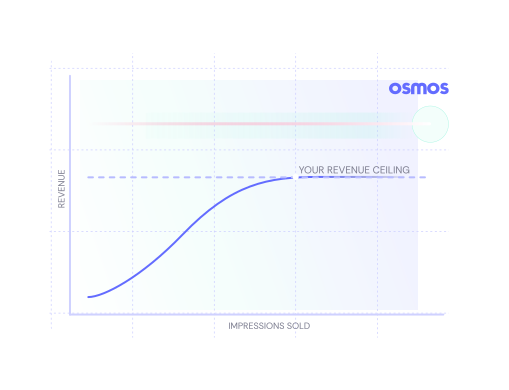
See what's above your ceiling.
Your score, your peer benchmark, and the levers that close the gap.
Commitment-free consultation on your top needs and challenges. Discover product capabilities and how Osmos may help.